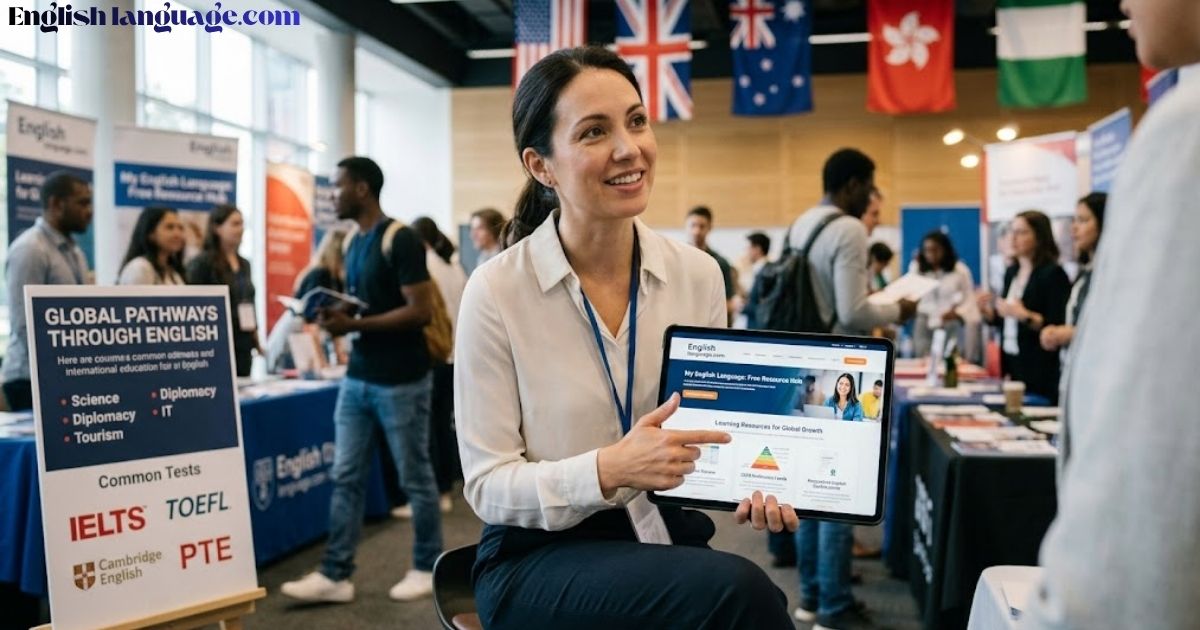
I have worked with learners for years, and I still see English as the most widely spoken language on our planet. About 1.5 billion people use it across fifty countries, according to Ethnologue. That reach makes it a true lingua franca for the whole world.
Think about science, diplomacy, tourism, IT, and the media industry. Each field links nations through one shared language, and each one pushes progress forward. Even online life runs mostly on English.
A parent plans for a child, a working professional chases a better career, and students aim for a university place. All of them want to understand, speak, read, and write with confidence. This guide on English language.com shows how the CEFR measures proficiency and which certificates prove it.
Why English language.com and Learning Resources Matter for Global Growth
I found My English Language, a free resource hub on English language.com, useful early on. It offers guides on grammar, vocabulary, pronunciation, business English, academic English, and cultural tips. Teachers also get classroom ideas for TEFL and EFL lessons.
English supports education, travel, and international business. It also opens up culture, because writing, films, and music all travel through it. I keep that in mind in every lesson I plan.
English as a Global Language
English holds official language status in 55 countries, mainly the USA, the UK, Australia, and New Zealand. In 27 territories, such as Hong Kong, the Isle of Man, and Puerto Rico, it has official status for dealing with government officials. People also speak it on almost all continents, including European countries, India, Pakistan, the Philippines, and Nigeria.
Counting native speakers gives different answers. One source says 380 million, while another says 360-400 million. By that count, English ranks as the third most-spoken native language, behind Chinese and Spanish.
The total speaker count tells a bigger story. Ethnologue calls English the most spoken language overall, ahead of Mandarin Chinese, with about 1.5 billion users, and 1.1 billion of them use it as a second language or foreign language. Another source counts 750 million who learn it as a second language and 600 million who learn it as a foreign language.
This global reach keeps demand high. The British Council says over 1 billion learners study English today, and Graddol in English Next sees projections of growth to 2 billion learners, led by China, India, and Africa. I notice the same pattern in my own classes, because English works as a lingua franca between people who share no other tongue.
How to Learn English Effectively
Research on second-language acquisition gives a clear answer. Krashen in 1985 described comprehensible input, and Swain in the same year described comprehensible output. Input alone builds passive understanding, but output builds active fluency.
I learned this the hard way: early on I leaned on grammar drills, and my speaking stayed weak. Things changed when I added conversation practice and language exchange. Now I push every student toward real-world use as a daily habit.
A balanced week mixes listening, reading, and writing, with graded texts, podcasts, and films as your input. Then you add speaking and short pieces of output to match. This routine builds listening comprehension and audio training, and it turns vocabulary expansion into a daily task.
To learn English fast, you should mix learning styles. Add grammar exercises and new vocabulary to reach advanced structures such as the gerund and the sequence of tenses. These steps sharpen your language skills, whether you study ESL or you are a native speaker who wants to improve.
Free authentic resources help a lot, and the British Council runs learnenglish.britishcouncil.org for every CEFR level. BBC Learning English at bbc.co.uk/learningenglish offers daily audio, video, and quizzes, while Cambridge English at cambridgeenglish.org gives exam-style practice. VOA Learning English at learningenglish.voanews.com shares news in simplified English across three difficulty levels.
Apps work well for habit-building. Duolingo, Babbel, Memrise, Rosetta Stone, and Mondly make daily practice easy. For speaking, I book live tutors on italki, Preply, and Verbling, and I swap languages on Tandem, HelloTalk, and Speaky.
Coursera, Udemy, Skillshare, and FutureLearn teach academic writing, business communication, and exam preparation. Pair them with structured study and structured immersion. That mix gives you confident fluency, and fluency only comes from steady output.
How Difficult English Is to Learn
English feels accessible at the beginner level. The sentence structure follows Subject-Verb-Object, and verbs change less than in many other Indo-European languages. That early win feels motivating, so new learners keep going.
The alphabet has 26 letters and 40 distinct sounds. People once counted a 27th letter, the ampersand, written as &, and today official speech uses it for a formal company or for the collaboration of two authors. I spot it on shop signs all the time.
Grammar brings 12 tenses. Learners start with 3 main tenses, past, present, and future, and each one splits into 4 aspects: simple, progressive, perfect, and perfect progressive. You need steady practice to use them well.
Spelling causes real trouble. One source says three-quarter words come from Latin, Greek, and French, which explains pairs like mouse-mice, criterion-criteria, and ox-oxen. This influence of other languages also confuses learners, because once someone has pronounced a word and written it, the two forms rarely match, as in enough, beautiful, debt, and sell-cell.
At the advanced level, complexity grows through pronunciation patterns and phrasal verbs. You need exposure to real speech and a feel for everyday life English. Consistent practice builds fluency, and shortcuts do not.

Why Learning English Is Worth It
English opens doors in international business, travel, and online communication. It builds the communication skills that international teams need. It also unlocks global culture, from books and music to journalism.
Higher education runs on English too. Most universities publish research and academic resources in it. That is why so many students study it before they apply.
The career effect shows up in numbers. A 2024 study by Pearson asked more than 5,000 ESL speakers in Japan, Saudi Arabia, Brazil, Italy, and Florida, in the United States. About 80% linked English to earning potential, and they valued strong skills like an 80% salary increase.
About 75% of advanced speakers felt happy with their pay, which shows real income satisfaction, while beginners reported far less. English is also the most widely studied foreign language in Europe. That means you join a big group of fellow learners and meet employers who expect it.
How Long It Takes to Learn English
Cambridge English says learners need 180 to 200 hours of guided learning to climb one CEFR level. That means a move from A2 to B1, or from B1 to B2. I tell my students to treat those hours as a rough map, not a promise.
Intensive study shortens the road. Two weekly lessons at home move much slower. Pick the pace that fits your life, and keep it steady.
Recognised English Certifications
Five families of certifications offer proof of language proficiency. All of them follow the Common European Framework of Reference for Languages. You can check details on britishcouncil.org, cambridgeenglish.org, ets.org, and pearsonpte.com.
IELTS, the International English Language Testing System, comes from the British Council, IDP IELTS Australia, and Cambridge. Scores run from Band 2 to Band 9, and they cover levels from A1 to C2. People use it for immigration to the UK, Australia, and Canada, and for professional registration and university admission.
TOEFL iBT, the Test of English as a Foreign Language, comes from ETS, the Educational Testing Service. It uses a 0 to 120 scale and covers A2 to C2. Many applicants pick it for study in the United States.
Key English Qualifications and Resources on English language.com
Qualifications from the University of Cambridge include B2 First, C1 Advanced, and C2 Proficiency, and the lowest one is Key. The Proficiency exam sits at the top, and B2 and C1 results carry strong weight. These results stay valid for life with no expiry date. You can explore detailed breakdown guides on English language.com to help choose the right path for your needs.
TOEIC, the Test of English for International Communication, targets workplace English and corporate English, mostly in Asia and Europe. Pearson PTE Academic uses a 10 to 90 scale and helps with visa applications. Pick the one your goal needs.
Most universities in English-speaking countries ask for B2 or C1 for academic admission. That usually means IELTS 6.0 to 7.5, TOEFL iBT 80 to 110, or Cambridge B2 First and C1 Advanced. I always check each school’s own rules first.
Frequently Asked Questions
1. Why should I practice speaking on English language.com?
English language.com provides interactive tools, real-time feedback, and engaging lessons designed to help you build confidence and speak fluently faster.
2. How long does it take to notice improvement in my English?
Most learners see noticeable progress within 2 to 4 weeks of consistent daily practice, even with just 15 to 20 minutes a day.
3. Is learning English suitable for absolute beginners?
Yes! Courses and practice tools are structured to support all skill levels, starting from foundational vocabulary to advanced conversation skills.
4. Can I practice English on my mobile device?
Absolutely. You can access practice materials, quizzes, and lessons seamlessly from any smartphone, tablet, or desktop computer.
5. What makes English language.com different from other platforms?
English language.com combines structured learning paths with practical daily conversation scenarios, ensuring you learn real-world English efficiently.