
Property development finance is the money that turns a stalled plot into a finished building, and I have sat in enough meetings to know the pattern.
A developer owns the land, holds the drawings, and still cannot start. This product fills that hole, because it works as a short-term funding solution and a secured business loan that pays you to build, renovate or convert a property.
Most development finance sits unregulated. You only need regulated development finance when 40% or more of the finished home becomes your primary residence.
If you are developing a property to sell or rent out, speak to a commercial broker who specialises in this field, because a good one lines up tailored finance options against your timeline and your risk profile.
How Does Property Development Finance Work?
A development finance transaction starts when a developer begins borrowing money from one or more lenders to fund the acquisition of land and the property development that follows.
Once the building stands completed, the owner either has it sold or keeps it as an income source for investment purposes. The money borrowed stays secured against the site and against the rights of the developer.
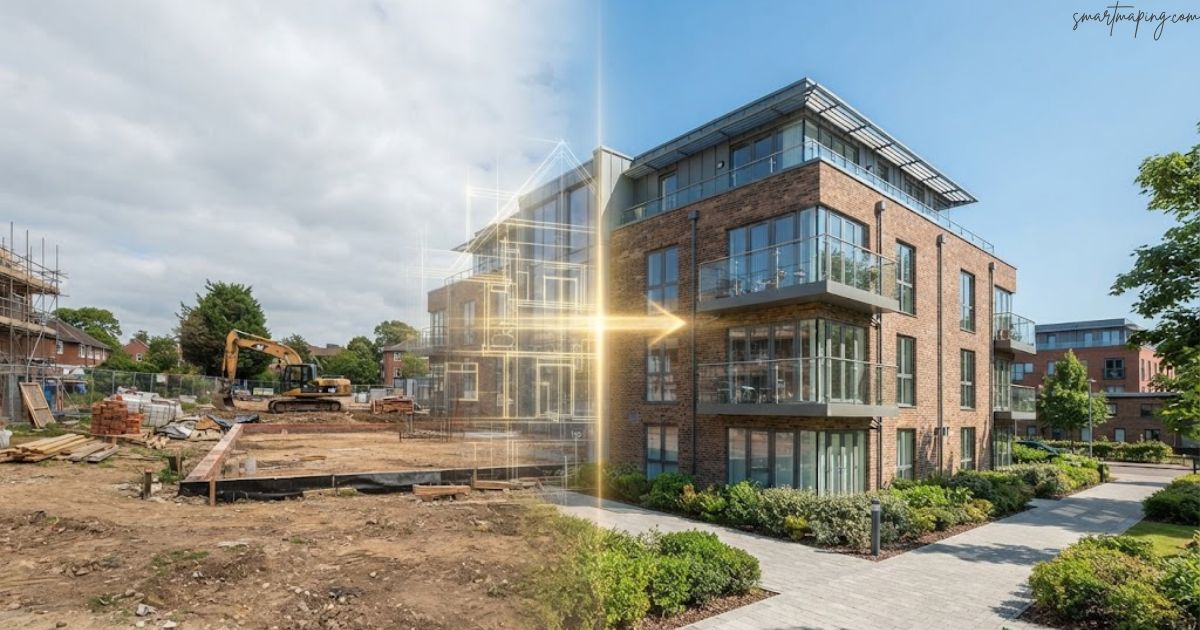
The key features of property development loans are easy to picture. Staged drawdowns mean a lender will release funds in stages as the project progresses, so funds released track the real progress of the development and help you manage cash flow.
These are short-term funding solutions by design. The short-term structure usually runs 6 to 24 months, with interest often rolled up and repaid at the very end rather than monthly. That single choice protects cash flow during construction, which matters when you juggle trades, weather and tight deadlines.
What Types Of Property Development Finance Can You Use?
Property development funding arrives in several shapes, and each one suits different project types, timelines and developer experience levels.
A residential build, a commercial conversion and a mixed-use scheme rarely share the same funding structure, and commercial property development finance in particular tends to carry tighter covenants than its residential cousin. Picking the right one protects both project viability and your margin.
Senior Debt And Standard Development Finance
Development finance, sometimes called senior debt, funds development projects from the ground up. Traditional development loans cover land acquisition, construction costs, build costs and other project-related expenses, and you can raise them through banks, specialised lenders or development finance institutions.
Bridging Loans
Bridging loans are short-term financing solutions that hand a developer quick access to capital. Buyers use them to bridge the gap between the purchase of a property and long-term funding, such as a mortgage or refinancing, and lenders admire them for flexibility and speed of approval.
Private Equity
Private equity raises capital from private investors or investment firms in return for a share of ownership or a return on investment. Deals run through limited partnerships or special purpose vehicles, known as SPVs, and the paperwork sets out how investors take their share of profits.
Joint Ventures
Joint ventures happen when two or more parties collaborate to develop a property project. You might end up partnering with an investor, another developer or a landowner, and together you pool resources, skills and equity so you share costs, share risks and split the rewards.
Mezzanine Finance
Mezzanine financing sits between your equity contribution and the money from traditional lenders. Mezzanine finance works as secondary funding and is usually structured as second-charge debt with higher interest rates. Developers reach for it to shrink the deposit, to plug a funding gap or to draw top-up funds mid-build.
Crowdfunding
Crowdfunding pulls small sums from many individuals through online platforms. You publish a proposed project, and potential investors back it in exchange for profits or other rewards, which lets you access capital quickly and reach a broader investor base. It only works with real marketing effort and a compelling project proposal behind it.
How To Prepare And Apply For Property Development Finance
Project Details and Initial Planning
Getting the application right saves weeks. Lenders all differ, yet every file needs the same project details: the purpose, scope, location, type of property, construction timeline, target market and expected outcomes of your property development project.
Set out the development plan clearly and keep the project’s scope honest.
Cost Breakdown and Financial Requirements
Then handle the numbers. Work out total costs and financial requirements across land acquisition, construction, professional fees, contingency funds and other associated expenses, and say exactly how the money gets allocated.
Name your funding requirements and be clear on the build costs and the gross development value, usually shortened to GDV.
Business Plan and Financial Documentation
Your business plan carries the argument. It should show objectives, financial projections, market analysis, risk assessment, a strategy for returns and a plain exit strategy.
Back it with financial documentation: personal and business bank statements, tax returns, financial statements, proof of income and details of existing liabilities or assets, all up-to-date and well-organised. Sloppy financial records kill more deals than weak schemes do.
Structuring Funding Mix and Professional Support
The UK development finance landscape turns complex fast, especially for first-time developers or anyone scaling up to larger projects. Before you apply, settle your funding mix and decide how much equity you can put in against senior debt, mezzanine finance or bridging loans.
Remember the sector is time sensitive, so match your build schedule to your sales or refinance plans, and lean on professional support from a broker who can negotiate terms and open a panel of specialist development lenders.
Five-Step Arrangement Process
In practice, arranging finance for property development runs in five steps. An initial consultation captures your project experience and funding requirements; a project assessment reviews planning status, key details, build costs, GDV and timelines.
A funding strategy weighs funding options, key funding options, finance structures and joint venture funding to maximise leverage while managing risk; lender matching finds competitive and flexible offers among suitable lenders; then application and approval follows.
Due Diligence and Loan Offers
After the application submitted stage, the lender will evaluate the scheme and run a due diligence process that may include site visits, financial analysis and risk assessments. Expect additional questions and extra documentation, and respond to lender queries within hours rather than days to lift your chances of approval.
Once the application-approved stage arrives, you receive an offer letter setting out the proposed loan terms, interest rates, repayment schedule and fees, and you can still negotiate.
A Note On Property Development Finance In Scotland
Property development finance in Scotland follows the same commercial logic, but the legal machinery underneath it differs.
Scots law uses a standard security rather than an English mortgage, and titles register with Registers of Scotland instead of the Land Registry. Your lender will still test GDV, exit strategy and track record in exactly the same way. The practical difference shows up in timing. Missives replace exchange and completion, so your solicitor needs to be Scottish-qualified and involved early, or your drawdown slips.
What Interest Rates And Fees Can You Expect?
UK lenders price property development finance on a case-by-case basis. They look at the amount you want to borrow, the project’s GDV and your experience with previous developments. Those three factors move the interest rate more than anything else.
Every borrower must also budget for fees on top. Development finance commonly carries arrangement fees, exit fees, administration fees, surveyor fees and legal fees. Fold them into your total costs at the appraisal stage, never at the end.
How Long Does It Take To Secure Development Finance?
The amount of time it takes to secure development finance depends on the complexity of your project and the thoroughness of your application. Realistically it runs from a few weeks to several months. Complex sites with planning conditions sit at the slower end.
Good practice says you should have financing in place well before construction on your property commences. I have watched sites sit idle for six weeks because funding lagged the programme. That delay costs more than the fee you were haggling over.
FAQs
How does property development finance work?
A lender advances money against your site in staged drawdowns, releasing funds as the construction progresses. Interest is usually rolled up and the loan is cleared through your exit strategy once the build is completed.
How to get 100% development finance?
No mainstream development finance lender covers 100% on its own, so you stack senior debt with mezzanine finance, joint venture funding or a private equity partner. You trade a slice of your profits for the missing equity, which is a fair swap when a good project would otherwise die on the shelf.
How can I get funding for property development?
Bring a costed business plan, live planning permission, a realistic GDV and proof of your track record, then approach a property development finance broker with access to a wide panel of lenders. Most developers contribute 20–40% of the total cost themselves.
Is property development still profitable?
Yes, but the margin now sits in the buying and the costings, not in rising prices. Watch build costs, hold a contingency fund, and check the demand in your location before you commit.
How much tax do you pay on property development?
If you build to sell, profits are trading income taxed through corporation tax or income tax; if you rent out and later sell, Capital Gains Tax usually applies instead. Stamp duty on the purchase and VAT on the works also bite, so speak to an accountant early.