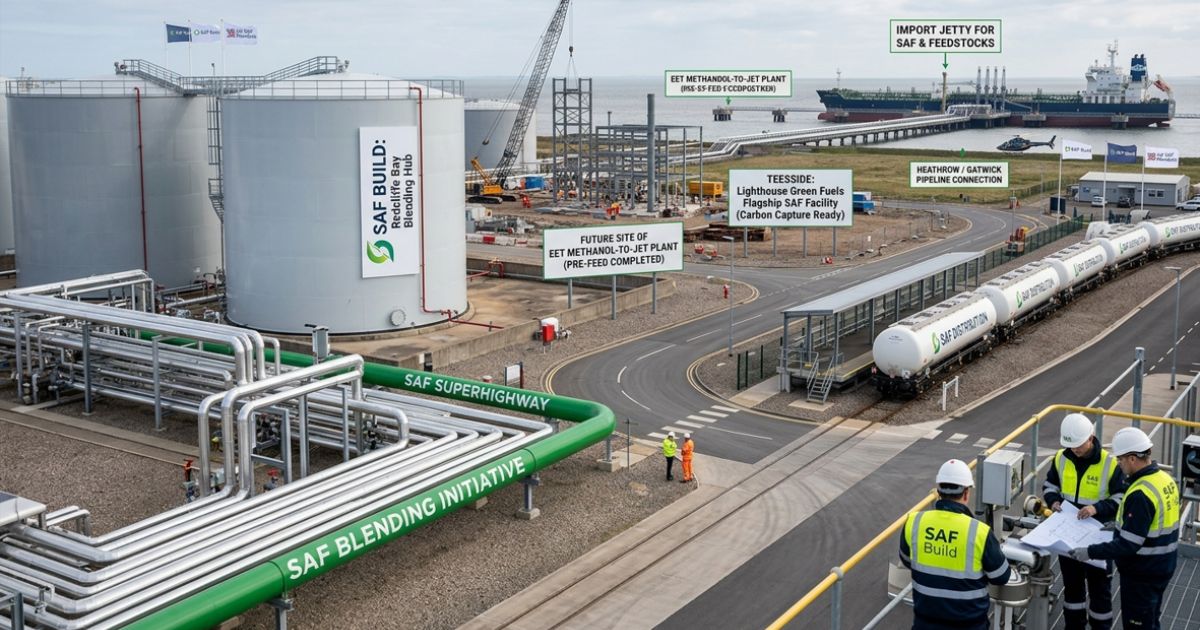
In 2025, mandates for sustainable aviation fuel (SAF) finally became real, and in 2026 the United Kingdom has to turn them into action. SAF producers need subsidies, investment, and steady access to jet fuel markets, because the global market rewards sellers who can reach the places where the rules suit their fuel. Airlines and fuel suppliers need enough volumes to meet those mandates, and regulatory requirements differ from country to country, so I see the SAF Build value chain as much more than a list of separate parts.
Strategic Infrastructure and Key SAF Build Developments
Even if homegrown SAF production hits its best targets, Britain’s airports will still rely on imported fuel for about three-quarters of their supply. Airport expansion at Heathrow and Gatwick adds even more demand. SAF trades as its own product and needs blending with JetA1, so storage and distribution matter as much as production capacity and production methods. The middle market of infrastructure for storage, blending, and moving fuel holds the whole SAF Build value chain together, and it decides how well feedstocks turn into fuel on the wing.
Real project delivery now backs up the UK Government’s policy ambition. Essar Energy Transition finished the Pre-FEED stage, also called Pre-Front End Engineering Design, for its Methanol-to-Jet (MtJ) plant at the Stanlow refinery. The plant would make more than 200,000 tonnes of SAF a year from renewable e-methanol and bio-methanol, which makes it one of the advanced SAF developments in the North West industrial cluster. Firefly, a waste-to-fuel developer, also moves forward, while Teesside hosts the flagship second-generation SAF project. Projects like this need an industrial ecosystem with land at scale, proven infrastructure, integrated logistics, skilled people, a path to deep decarbonisation, and the right technology at commercial scale. All of it matters to every SAF Build initiative across the downstream fuels sector, airports, and refinery owners.
The crucial role of terminals and pipelines
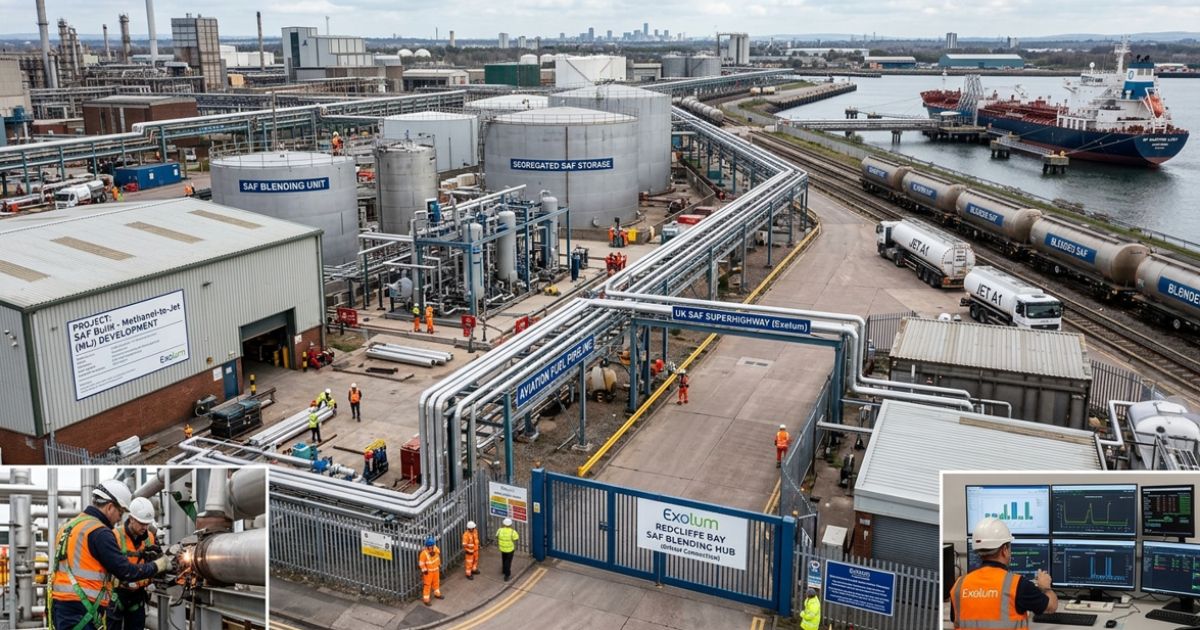
Infrastructure decisions shape everything in this business. Airports sit at the end of the chain but often lack scalability and local expertise, and refineries handle large volumes but focus on conventional production, so they struggle with special blending operations. Exolum answers this with its SAF Superhighway, which it builds on the existing aviation fuel pipeline and terminal network. Established aviation fuel terminals bring expertise and capacity, operational know-how, large-scale blending capabilities, supply resilience, multiple tanks and room for extra segregation capacity.
The pipeline also delivers reduced costs and emissions, with lower transportation costs and carbon emissions than road transport, which helps the industry reach its carbon targets. Seamless integration through existing pipeline connections avoids double handling of conventional jet fuel such as JetA1 and gives open access to anyone who joins the SAF blending market. Pipeline networks link producers to airports and form the backbone of the middle market. Moving fuel by pipeline cuts greenhouse gas emissions by 99% compared with heavy goods vehicles (HGVs). Exolum’s 2,000 km system covers 50% of the British network and takes the equivalent of 200,000 JetA1 HGVs off UK roads every year. The UK has about 600,000 registered HGVs, so replacing the pipeline with trucks would add 33% to the national HGV fleet and worsen road congestion.
Realising the value of existing infrastructure
Co-locating SAF production inside the Stanlow manufacturing complex lets EET use its blending capability and logistics infrastructure. That includes the Manchester Jet, Midlands and UKOP pipeline systems, plus road and marine distribution routes. The Department for Transport supported the Pre-FEED study through its Advanced Fuel Fund, and the study checked site suitability, technology readiness, refinery integration, carbon intensity and environmental compliance. It found no material barriers to permitting and spotted ways to cut project costs.
The plant helps EET with SAF mandate compliance under the UK SAF Mandate, and it also serves the wider UK aviation market. EET plans to enter the FEED stage soon and aims for a Final Investment Decision in early 2028, with offtake already part of the plan. Ruth Herbert, Managing Director and Chief Business Development Officer, calls it a fully integrated, delivery-ready solution that is built for scale. She says it lowers risk, cost and complexity inside a large-scale refinery system that already has existing infrastructure, logistics and blending in place. For the liquid fuels sector, this shows that refining sites and refinery assets keep a strategic role across the UK.
A blueprint for the future
SAF producers gain the most when they see the wider SAF supply chain, and Exolum already has a long record in the biofuels sector. Its terminals store feedstocks for biofuel production plants and hold intermediate and finished products. Its distribution network supplies jet fuel for 40% of flights that leave the UK. To grow this role, investment must convert liquid tanks and build segregated storage facilities for blended SAF and unblended SAF. It must also use deep-water jetty capacity for imported SAF, add multi-modal connectivity by rail, ship/barge and road, and extend pipeline coverage. Exolum wants to attract money into new pipeline connections, expanded jetty capabilities and better rail network connectivity.
Exolum already acts on this plan. It committed £4.5 million (€5.2 million) to the first SAF blending hub at Redcliffe Bay near Bristol, partly because of the SAF mandate from the Government. The site connects producers to the aviation fuel pipeline network and sends fuel to Heathrow and Gatwick, and to regional airports such as Bristol, Cardiff and Exeter. The work covers tank conversion, pumping facilities, a blending rig, filtration systems and segregation valves. The hub starts with imported SAF, then opens the way for domestic SAF production from 2028 and gives producers access to the aviation fuel marketplace.
Writing infrastructure into policymaking
Market-first moves need capital, and private sector investment carries the supply chain while the SAF ecosystem is still nascent. The Sustainable Aviation Fuel Bill, the mandate and airport expansion plans give demand certainty, and that certainty builds bankable projects. Policy can also show the environmental superiority of a pipeline network, simplify regulatory compliance and shape a national distribution system. Together, these steps de-risk SAF logistics infrastructure, make it cost-effective and resilient, and deliver SAF mandate volumes and greenhouse gas reductions for the aviation sector.
The infrastructure imperative
Decarbonising aviation has no silver bullet, and I think of it as a logistics challenge as much as a technological and regulatory one. The middle market of storage, blending and distribution acts as the critical enabler between production and consumption. When the UK backs this infrastructure, it turns net-zero aviation into a scalable reality instead of a distant goal.
A step-change in scale, integration and deliverability
A larger site brings a real step-change for the project. The consolidated footprint puts feedstock receipt and storage, feedstock pre-treatment, gasification, Fischer–Tropsch synthesis, upgrading, storage and outbound logistics in one place. That creates a fully integrated facility with fewer interfaces, which lifts efficiency and cuts emissions across the value chain. Better scale, integration and deliverability follow from that simple design choice.
Single-site SAF production
A single-site plant makes delivery simpler, and lower execution risk comes straight from fewer hand-offs. Operational efficiency rises because direct feedstock delivery gives tighter process control, lower lifecycle emissions and optimised plant performance. Capital efficiency comes from modular equipment that cuts on-site construction costs, and auditable processes give investor certainty over the long run.
Teesside: the right home for the UK’s flagship SAF facility
Lighthouse Green Fuels chose Teesside for its flagship plant because the location brings clear logistical advantages. Those advantages support smooth delivery and strengthen the project’s economics. Each one, from the quay to the rail link, adds to the case for building here.
Quay access
Direct quay access helps during construction and daily operation. Construction equipment and feedstock arrive with less reliance on trucks, and jetty access lets the site ship out SAF and green naphtha by marine transport. This improves outbound logistics, opens domestic and international markets and strengthens operational resilience.
Access to road and adjacent rail facilities
The site links to road and adjacent rail facilities, and this gives the plant flexibility for the long term. Teams can move materials and products by the best route on any given day. That choice keeps the plant steady when conditions change.
Carbon capture readiness
Carbon capture readiness matters because Teesside sits at the heart of the UK’s industrial decarbonisation strategy. Lighthouse Green Fuels has a clear path to carbon capture and storage (CCS) through the local CO₂ transport and storage infrastructure. This can cut lifecycle emissions further and even open the door to carbon-negative SAF. It supports the net-zero pathway, moves Britain toward next-generation aviation fuels and brings industrial-scale SAF to future flight.
Broader Industry Progress Across the SAF Build Ecosystem
The Stanlow news shows that SAF has moved past early-stage concepts into real technology partnerships, feedstock partnerships, and infrastructure partnerships. Firefly, a Bristol-based SAF developer, teamed up with Altaca, a Turkish engineering company, for hydrothermal liquefaction technology. Its “wet-to-jet” process turns treated sewage sludge and biosolids into crude oil before downstream refining. Firefly will take feedstock from UK water companies, use Chevron Lummus Global for refining, and already holds a 15-year offtake agreement with Wizz Air. That partnership completes a key link in the broader SAF Build framework and moves commercial scale deployment closer across Britain.
FAQs
1. What is SAF Build?
SAF Build refers to the strategic framework and construction methodology used to design, assemble, and scale sustainable aviation fuel (SAF) production facilities.
2. Why is sustainable aviation fuel important?
Sustainable aviation fuel significantly reduces lifecycle carbon emissions compared to conventional jet fuel, serving as a primary pathway to decarbonize the aviation industry.
3. What feedstocks are used to produce SAF?
SAF can be produced from renewable resources such as used cooking oil, animal fats, municipal waste, agricultural residues, and captured carbon dioxide.
4. Is SAF safe to use in commercial aircraft?
Yes, approved SAF pathways are “drop-in” fuels blended up to 50% with traditional jet fuel and meet the exact same safety and performance specifications.
5. What factors drive a successful SAF Build project?
A successful SAF Build relies on reliable feedstock supply chains, scalable processing technology, supportive regulatory policies, and securing long-term off-take agreements.