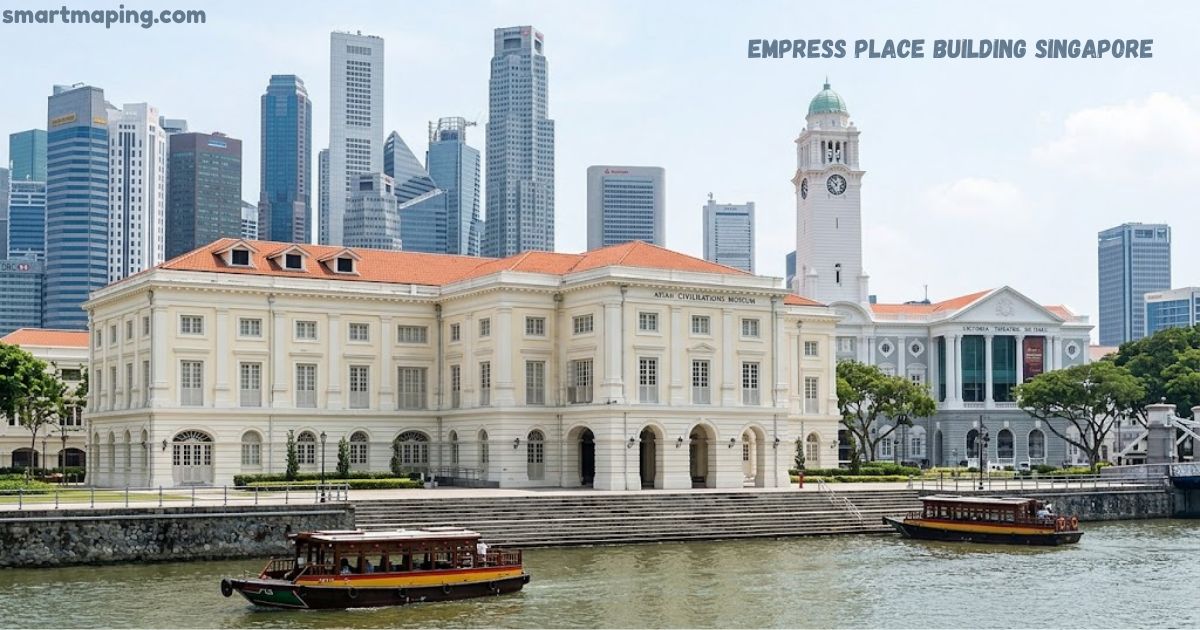
The Empress Place Building Singapore, also known as the Former Empress Place Building, stands beside the Singapore River, and it has watched colonial Singapore grow since the 1860s. Roughly 200 years have passed since Stamford Raffles founded the modern city of Singapore, yet the Empress Place Building still looks sharp. Today it houses the Asian Civilisations Museum, and the building deserves as much attention as the museum exhibits inside it.
Empress Place Building Singapore
Most people link Singapore with cutting-edge architecture, but the city also keeps many heritage buildings from colonial times, and the Empress Place Building Singapore ranks among the best of them. The grand facade shows that this was an important government building, where government officials ran administrative life and commercial life every day. Inside, you can explore Asian art, faith, design and trade under one roof.
A short walking distance takes you into the Civic District, where several National Monuments stand close together. The Old Parliament House dates to 1827, and it is the oldest government building and the oldest surviving building in the Civic area. It housed the Parliament of Singapore from 1965 to 1999, and today The Arts House occupies it. Of the ten heritage buildings on a popular city walking list, this cluster gives you the most in the least time.
Next door, the Victoria Theatre and Concert Hall began life as a town hall in 1862. Builders later added a second public hall and joined both with a clock tower. A four year-long refurbishment ended in 2010, and now the theatre and concert hall look brand new.
Before it was ACM, the Empress Place Building Singapore was the government HQ
Work began in 1864 under Major John F. A. McNair, the colonial engineer who also shaped the Istana and St Andrew’s Cathedral. John McNair chose the Palladian style, and builders raised the site on the north bank of the river in four phases until 1920. Leaders first planned a courthouse at the Empress Place Building Singapore site, but funds went to military spending and slowed the project.
The main block opened in 1867, although one record lists the Government Secretariat as the first occupant in 1865. Departments left Maxwell’s House, which is now The Arts House at the Old Parliament, and moved in. The Secretariat worked beside the Treasury and Stamp Office, the Public Works Department, the Medical Departments, the Colonial Engineer’s office and the Inspector General of Police. So many government offices shared one roof that people simply called it the Government Offices, and that name shows how the colonial government worked.
The royal name of the Empress Place Building Singapore came later. In 1907, officials named the public space outside Empress Place in memory of Queen Victoria. After World War II, crowds gathered there to push for self-government, and in 1956 Chief Minister David Marshall called for Merdeka, or independence, in a fiery speech.
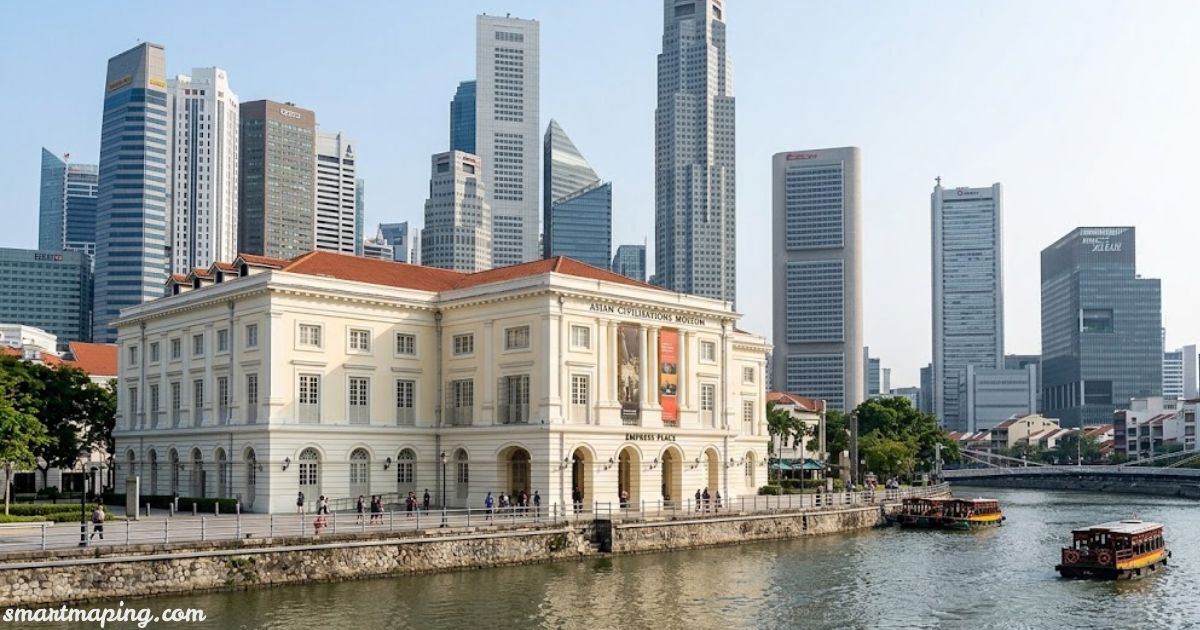
After 1965, the Citizenship Registry, the Immigration Department and the Registry of Births and Deaths all worked inside. In the late 1980s, the government offices moved out for restoration and conservation. A 14-month renovation followed, and on 7 Apr 1989 the Empress Place Museum opened with an inaugural exhibition of Qing dynasty furniture and other artefacts. Too few visitors came, so the museum closed in 1995 after six years.
Meanwhile, the Asian Civilisations Museum opened in 1997 at the Former Tao Nan School on Armenian Street, which is now the Peranakan Museum. Lee Hsien Loong, then Deputy Prime Minister, attended that opening. In 1998, Public Works crews started the restoration and expansion works, and on 1 Mar 2003 the building reopened as the second wing. The first wing closed in 2005, so the Empress Place Building Singapore is now the home of ACM.
What to look out for when you visit ACM
Look up before you look into the display cases. The Neoclassical facade wins you over with its symmetry, columns, arches and pale exterior, especially against the CBD skyline. The Empress Place Building Singapore is more than 150 years old, and it counts as a 19th-century National Monument. Once you know that almost the whole colonial government worked here, the grand look makes sense.
The French windows deserve a second glance too. Before air-conditioning, they helped ventilate the rooms and ease the tropical weather for the staff, which makes them a fine example of functional architecture. They look pretty, but they also did real work.
The 2015 revamp added the Kwek Hong Png Wing, a three-storey contemporary extension that sits beside the old block like a modern box. The contrast of old and new works better than you might expect. The Riverfront Wing, with its titanium entrance, faces the Singapore River, which once served as a busy trading port, so the ACM location fits its story.
Inside, the permanent galleries follow themes such as Maritime Trade, Faith and Belief and Materials and Design. The Court and Company Gallery and the Scholars Gallery add more depth. Together they show how Asian trade, migration, cultural exchange and artistic traditions crossed borders, instead of treating each civilisation alone.
FAQs
What is special about Empress Place?
It mixes a grand facade and Neoclassical style with a colonial past as the Government Offices, and today it houses the Asian Civilisations Museum beside the Singapore River.
What is the history of Empress Place in Singapore?
Builders began work in 1864 under John McNair, and the government offices opened in 1867. After a restoration in the 1980s, it became the Empress Place Museum and later the Asian Civilisations Museum, which reopened here in 2003.
What is the most iconic building in Singapore?
Many people name Marina Bay Sands as the modern icon. For heritage, the Empress Place Building stands out as a National Monument with real colonial charm.
What is the Empress building used for today?
The Empress Place Building is now home to the Asian Civilisations Museum, where visitors enjoy Asian art, trade and cultural exchange under one historic roof.
What is the Empress State Building used for?
This question seems to mix up two names. The Empire State Building in New York is an office tower with a famous observation deck. The Empress State Building is a separate London office tower, and neither relates to Singapore.